

A New Lens on Familiar Courses: Exploring Flourishing in the Core
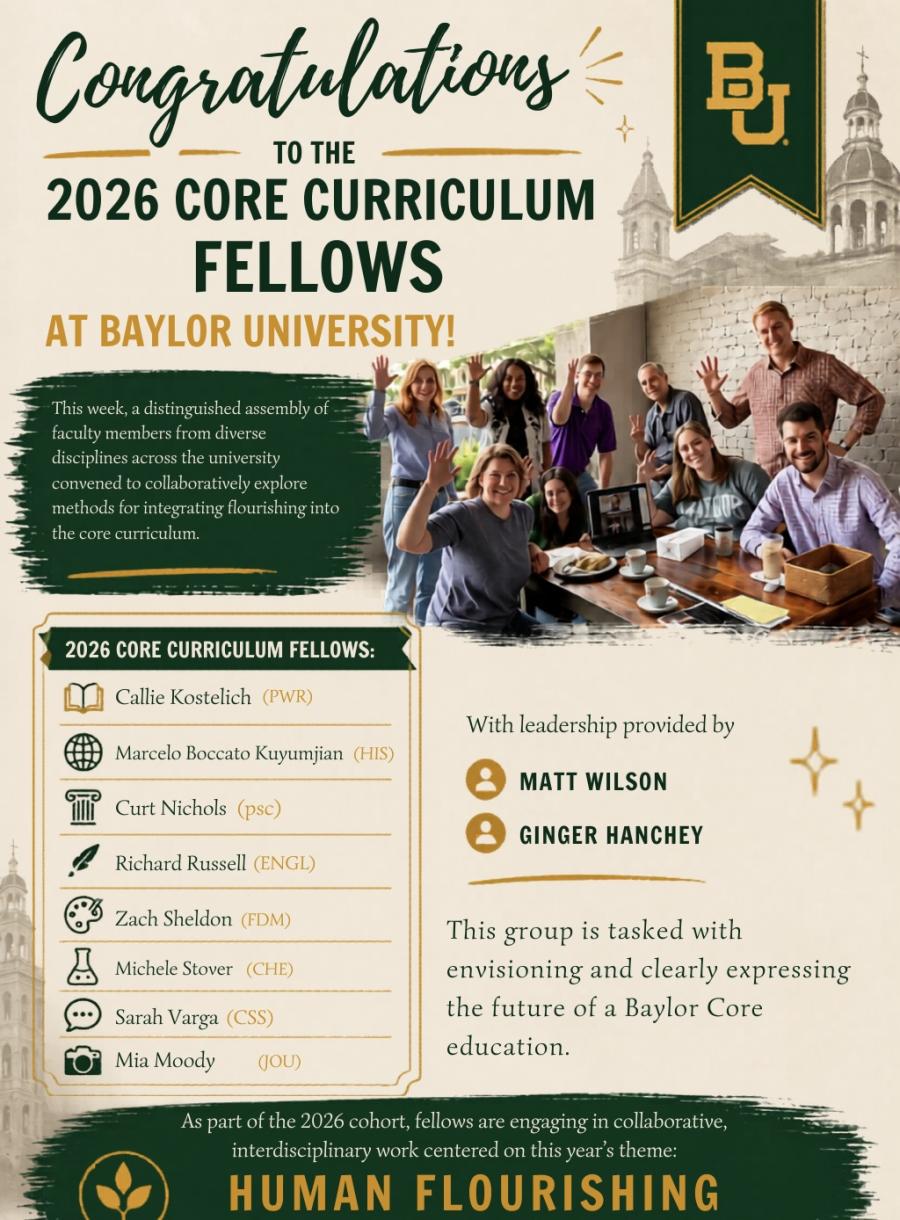
What happens when faculty are invited to look at their own courses through the lens of human flourishing? This May, eight Core Fellows from across Baylor's College of Arts & Sciences spent four days exploring that question in a workshop that was, by design, as much an experiment as a course-design exercise.
From May 18 to 21, the Institute for Global Human Flourishing joined The Ethics Center at Baylor and the College of Arts & Sciences to sponsor the 2026 Core Fellows May Workshop, Human Flourishing in the Core Curriculum. The aim was modest and concrete: introduce faculty to the flourishing framework, then ask how it might fit a Core course they already teach. Dr. Matthew F. Wilson and Dr. Ginger Hanchey, Director of the Core, facilitated the week, with sessions led by Dr. Matthew T. Lee, Dr. Jody Fry, and Jenni Oaks.
A genuinely interdisciplinary room
Part of what made the week worthwhile was the range of disciplines around the table. Fellows came from English, history, political science, professional writing and rhetoric, journalism, communication studies, and film and digital media, joined by a colleague from chemistry. These are faculty who already teach the texts, images, and public conversations through which people work out what it means to live well. The workshop's job was simply to give them a shared vocabulary and an empirical foundation for some of that work.
The Institute helped anchor that foundation. Sessions introduced Fellows to the six-domain framework behind the Global Flourishing Study, one of the largest longitudinal studies of human flourishing yet conducted, and explored where its findings touch questions each discipline already raises.
Naming what was already there
The clearest takeaway of the week was not that faculty overhauled their courses. It was that the framework gave them language for commitments already present in their teaching. As one Fellow put it, having a label and a defined framework for what they had been doing would help them plan more effectively and communicate the larger goals of a course to students.
That theme showed up across the cohort. Many of the most promising ideas were less about adding something new than about naming, sharpening, or re-emphasizing something already present, now seen through a flourishing lens. The directions Fellows explored were varied:
- Curt Nichols sketched a semester-long thread for his course on the U.S. Constitution, tracing "the paradox of the pursuit of happiness" from the Declaration of Independence forward.
- Callie Kostelich leaned further into the slow, embodied writing pedagogy she already favors, framing writing as a deliberative human practice with fresh resonance in the age of generative AI.
- Mia Moody began outlining a module inviting students to examine how social media circulates narratives of "living your best life."
- Richard Russell considered foregrounding beauty as a gateway to flourishing and faith in texts he already teaches.
- Zach Sheldon revisited his film discussion prompts to ask which characters flourish and how a film's craft shapes those messages.
- Michele Stover added an optional assignment to general chemistry, building on relational practices already in her course by letting students earn a replacement quiz grade through documented group study.
- Sarah Varga introduced a "Day 1" flourishing framing and a few rotating in-class exercises across two communication courses.
These were starting points more than finished revisions, and that was the point. Some were more structural and some simply additive, but each entered through the discipline's own methods rather than flattening them.
The relational element
If one thread tied the week together, it was the value of relationship. Dr. Lee's session on flourishing pedagogy modeled, rather than merely described, how teaching can invite students into a shared project of learning through practices like structured gratitude, brief check-ins, and mutual appreciation. Several Fellows picked up those practices for their own classrooms. Many also noted that the cohort itself, with new relationships formed across departments, contributed to their own sense of flourishing as faculty.
An honest, curious cohort
Fittingly for a research university, the week made room for hard questions. Fellows pressed on what distinguishes flourishing from well-being, on how flourishing is best measured, and on what it would really mean for Baylor to become a flourishing campus. The scrutiny was welcomed because it sharpens the work and models the kind of disciplined engagement we hope students will bring to the theme themselves.
What comes next
The workshop offered an early, encouraging answer to a real question: flourishing can find a home in the Core, not as an add-on, but through the distinctive strengths of each discipline. The revisions explored this spring are first steps, and durable change in the classroom will take follow-through. A mid-year touchpoint with the cohort will help the Institute learn which ideas took root and with what effect.
We are grateful to The Ethics Center at Baylor and the College of Arts & Sciences for partnering with us, and to the eight Fellows who were willing to experiment. Weeks like this are where a large aspiration meets the everyday work of teaching, and we are grateful to the participants for their contributions.